
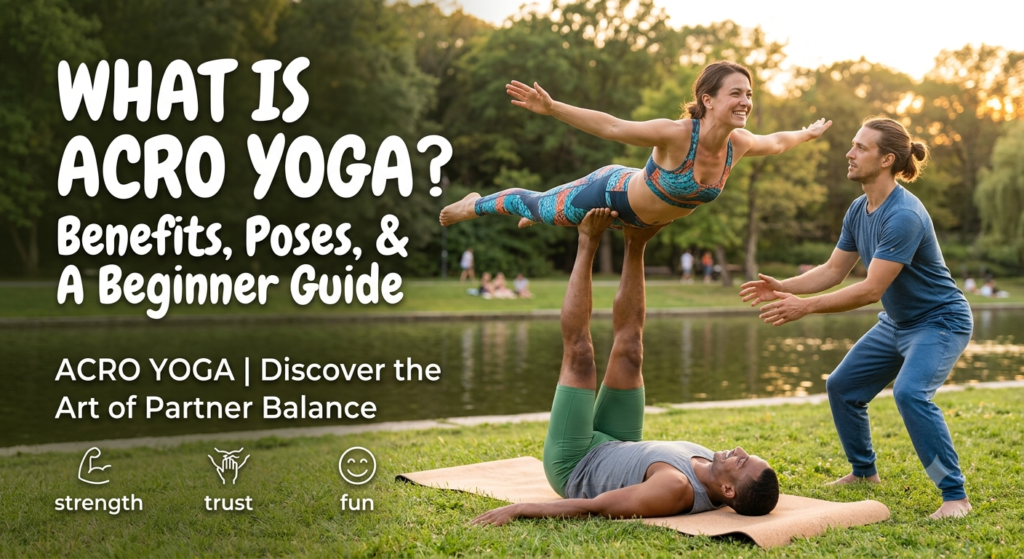
Have you ever seen two or three people flying, balancing, and flowing together in a graceful dance? This isn’t gymnastics or circus tricks it’s acro yoga. It’s one of the fastest-growing forms of yoga today, performed in parks, studios, and festivals around the world. Once you try it, you’ll understand why so many people love it.
Acro yoga isn’t just a workout. It’s a blend of acrobatics, yoga, and healing touch. It builds genuine trust between people and turns fitness into a sport instead of a boring gym routine. In this guide, we explain what acro yoga really is, its three different styles, its science-based benefits, how beginners can get started safely, and answer the most common questions.
What is acro yoga?
Acroyoga is a partner-based practice built on three pillars:
Acrobatics – physical lifts, balance, and dynamic movement
Yoga – breath control, focus, and body awareness
Thai massage healing, therapeutic touch used to conclude a practice session
In a typical pose, one person (the base) lies on the ground and supports another (the flyer), who balances on their hands and feet in the air. A third person, the spotter, stands nearby to prevent falls and guide the flyer safely in and out of poses. Just as the five elements of nature earth, water, fire, air, and space, known as the Panchatattva work together to create balance in the universe, acroyoga combines strength, breath, trust, and connection to create balance between two or more bodies.
The Three Styles of Acro Yoga (Most Blogs Skip This)
Most articles treat Acro Yoga as one single activity, but practitioners actually train in three distinct branches:
| Style | What It Focuses On | Best For |
| Solar Practice | Dynamic acrobatics, lifts, washing machines, standing acrobatics | Building strength and confidence |
| Lunar Practice | Slow, therapeutic Thai-massage-based flows and stretches | Relaxation and deep trust-building |
| Acrobatic (Circus) Practice | High-level tricks, hand-to-hand balancing, pyramids | Advanced practitioners and performers |
It’s important to know this difference because a beginner acro yoga class almost always focuses on solar and lunar practice first acrobatic circus-style tricks come much later, often after months of consistent training.
A Brief, Honest History
Acro yoga was officially developed in San Francisco in the early 2000s, thanks largely to Jason Nemer and Jenny Sauer-Klein, who co-founded Acro Yoga International in 2003. They combined contact improvisational dance, Thai massage, and yoga philosophy to create a structured practice with its own vocabulary of pose names, hand gestures, and safety protocols many of which are still taught in certified teacher training today.
Why is acro yoga so popular right now?
People are choosing acro yoga because it offers something that a treadmill or solo yoga mat can’t real human connection. In a world where most of us interact through screens, acroyoga requires eye contact, physical confidence, and constant verbal communication. It’s fun, social, and truly makes people feel alive. Proven Benefits of Acro Yoga
1. Builds Functional, Whole-Body Strength
The base primarily loads the legs, glutes, and shoulders (often with 100% of the flyer’s body weight above the head in poses like High Flying Whale). The flyer relies almost entirely on core and postural strength to remain stable. This type of load-bearing, multi-joint work builds functional strength that translates directly into everyday movement unlike isolated gym exercises.
2. Sharpens Balance and Proprioception
Balancing on a moving human base (not a fixed floor) forces your nervous system to constantly make small adjustments. Studies on partner-balance training show that this type of proprioceptive challenge improves reaction time and body awareness faster than static balance work alone.
3. Builds Trust and Communication Skills
Acro yoga cannot be done silently. The base and flyer use the same vocabulary of verbal cues (ready, down, coming out) before each change. This consistent, structured communication is one reason why many corporate team-building programs and couples workshops now use acro yoga as a trust exercise.
4. Reduces Stress Through Breath and Touch
Like traditional yoga, acro yoga uses ujjayi-style breathing to maintain calm under physical load. Add therapeutic Thai massage at the end of the session, and the parasympathetic nervous system (your rest and digest mode) is activated, which lowers cortisol and reduces anxiety.
5. Builds Real Confidence
Even rising a few inches off the ground triggers a natural fear response. Learning to breathe with that fear, trusting your ground, and holding a pose builds a special kind of confidence that translates to other areas of life public speaking, risk-taking, and decision-making.
6. Builds Real Community
Acro yoga jams informal open practice sessions in parks are a key part of the culture. Unlike solo gym sessions, you can’t avoid meeting people; poses require a partner, so jams naturally create a supportive, non-judgmental community.
7. Improves flexibility without static stretching
Regular practice opens the hips, shoulders, and hamstrings through active, weight-bearing stretches, rather than passive holds, which some practitioners consider more effective for long-term flexibility.
Who Should Try Acro Yoga (and Who Shouldn’t)
Acroyoga welcomes all body types, ages, and fitness levels you don’t need to be flexible, thin, or yoga-fit to get started. Bases are often chosen for stability and a lower centre of gravity, not size, and flyers are chosen for core control, not weight. However, you should consult a doctor before starting if you:
- Have a recent spinal, shoulder, or wrist injury
- Have uncontrolled high blood pressure or a heart condition
- Have severe vertigo or balance problems
Beginner Poses to Start With
Bird Pose (Front Bird) – The flyer lies face down on the base’s feet, arms outstretched.
Throne Pose – A supported seated pose, an ideal first pose for new couples.
Front Plank – The flyer planks on the base’s feet.
Star Pose – The flyer balances on the base’s feet, arms and legs wide apart.
Always learn these poses from a certified instructor before attempting anything high or too dynamic.
How to Start Practising Acro Yoga Safely
Find a certified class or local jam search Acro Yoga Jam near me, most cities have free weekend park sessions.
- Choose a trained instructor who is certified by a reputable acro yoga training body.
- Wear fitted clothing no loose jewellery, watches, or loose clothing that could get caught or slip.
- Warm up properly do 10 minutes of dynamic stretching before any pose.
- Start with lunar or ground-level poses, not dynamic flying tricks.
- Use standard verbal cues (ready and down) each time.
- Debrief after each session ask your partner what felt good or unsafe.
- Safety rules that really matter.
- Always practise on a soft surface a thick yoga mat, grass, or crash pad.
- Use a spotter for any pose above shoulder height.
- Never try a new pose without someone who knows it firsthand.
- Stop immediately at any sign of pain, dizziness, or numbness.
- Trust builds gradually don’t rush your partner or yourself.
Common myth: Acro yoga is only for couples.
- This is one of the most repeated myths online, and it’s false.
- Acro yoga communities are primarily built around friendship and open jams, not romance.
- Many lifelong friendships and yes, sometimes relationships begin at an acro yoga jam, but the practice itself is designed for any two willing, communicative partners.
1. Is Acro Yoga safe for beginners?
Yes. Acro Yoga is safe for beginners when you start with ground-level Lunar and Solar poses, use a spotter, and learn from a certified instructor. Injuries mostly happen when beginners skip proper warm-up or attempt advanced flying poses too early.
2. Do I need to be flexible or strong to start Acro Yoga?
No. You don’t need existing flexibility or strength Acro Yoga builds both over time. Bases need stability more than muscle size, and flyers need core control more than raw flexibility, so most people improve quickly with regular practice.
3. Can I practice Acro Yoga alone at home?
Not the partner poses, since they require a base, flyer and often a spotter for safety. However, you can prepare your body alone through core strengthening, shoulder stability work, and solo yoga stretches, which make partner sessions easier and safer.
4. How is Acro Yoga different from normal yoga?
Traditional yoga is practiced solo and focuses on individual poses, breath and meditation. Acro Yoga adds a partner (or trio), combining acrobatic lifts and Thai massage with the same breathing and mindfulness principles found in traditional yoga practice.
Final Thoughts
Acro Yoga is far more than a passing trend it’s a structured practice with its own history, styles and safety culture, built on genuine trust between people. It builds strength, flexibility, confidence and community, all while feeling like play rather than a workout.
If you’re ready to try it, find a local jam, bring a willing partner, and start with the Lunar practice basics. Your body and your sense of connection to others will thank you.