
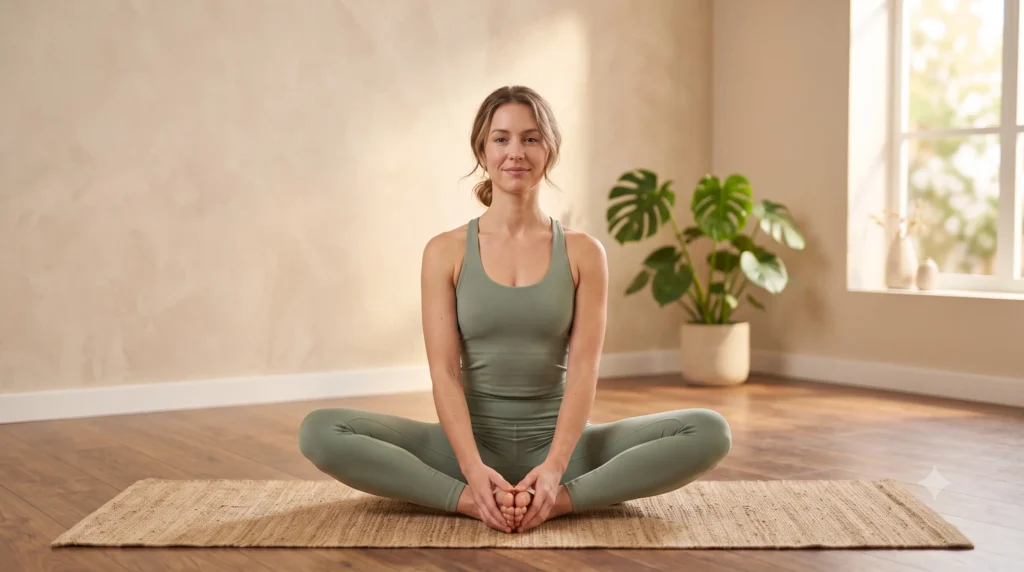
If you’ve ever struggled to sit cross-legged for a long meditation session, Bhadrasana may be the right pose for you. Also known as Gracious Pose or Throne Pose, Bhadrasana is a simple sitting pose that has been used in yoga and meditation practices for centuries. Understanding the benefits of Bhadrasana can help you decide if this gentle pose deserves a place in your daily routine.
What is Bhadrasana?
The word “Bhadrasana” comes from Sanskrit. “Bhadra” means gracious, auspicious, or strong, and “asana” means pose. Combined, it roughly translates to “graceful pose” or “throne pose.”
Bhadrasana is a sitting pose in which the soles of the feet are brought together in front of the body, similar to Butterfly Pose (Baddha Konasana), but with a straighter spine and a stronger base. It is traditionally used as a meditation pose because it allows the body to remain still and steady for extended periods. This pose is often recommended for beginners who find cross-legged poses like Padmasana (Lotus Pose) challenging, as it is gentler on the knees and hips and still opens those areas.
A Brief History of Bhadrasana
Bhadrasana is mentioned in traditional Hatha Yoga texts, including the Gheranda Samhita, as one of the ideal seated postures for long-term meditation. For centuries, it has been valued not for its difficulty but for its stability and comfort, qualities that have made it a favorite posture for yogis during long periods of calmness and breathwork.
How to Do Bhadrasana (Step-by-Step)
This is an easy way to do Bhadrasana at home.
Steps:
- Sit on the floor with your legs extended forward.
- Bend both knees and bring the soles of your feet together, leaving your knees open to the sides.
- Bring your ankles as close to your body as comfortably possible.
- Hold your feet together with both hands, or place your hands on your knees.
- Keep your spine straight and your shoulders relaxed.
- Close your eyes and breathe slowly and evenly.
- Hold this pose for 1-5 minutes, or longer if you’re using it for meditation.
Common Mistakes to Avoid
Many beginners unknowingly make small mistakes that diminish the benefits of Bhadrasana or put unnecessary strain on the body. Be mindful of these:
Rounding your back instead of keeping the spine straight.
- Pulling your legs too close to the body before your hips are ready, which puts strain on the knees.
- Forcing your knees to touch the ground, which can strain the hip joints over time.
- Holding your breath instead of breathing slowly and evenly throughout the pose can be detrimental.
- Tensing your shoulders, which adds unnecessary stress and counteracts the pose’s calming effect.
- Looking down with your chin tilted instead of keeping your neck neutral and aligned with your spine can lead to discomfort.
- Correcting these small habits can make a noticeable difference in both comfort and results.
Muscles Worked in Bhadrasana
Understanding what Bhadrasana works on may help you appreciate why it feels the way it does.
Muscles Stretched:
- Inner thighs (adductors)
- Groin muscles
- Hip flexors
- Muscles around the knees and ankles
Muscles Engaged and Strengthened:
- Lower back muscles, which work to keep the spine upright
- Core muscles, engaged lightly to support good posture
- Pelvic floor muscles, activated indirectly through the seated position
This combination of gentle stretching and light engagement is part of why Bhadrasana feels both relaxing and grounding at the same time.
Bhadrasana Benefits
Let’s look at the main benefits of Bhadrasana that make it a valuable addition to your yoga practice.
1. May Help Open the Hips and Groin
Bhadrasana gently stretches the inner thighs, groin, and hip area. Regular practice may help improve flexibility in these areas over time, which can also support other seated and standing poses.
2. May Support Better Posture
Since Bhadrasana requires you to sit with a straight spine, it may help train your body to sit taller and more upright, both during practice and in daily life.
3. May Prepare the Body for Meditation
Because it is a stable, grounded seated pose, Bhadrasana is often used as a preparatory posture for longer meditation sessions. It may help you sit comfortably for extended periods without discomfort in the knees or ankles.
4. May Aid Digestion
Some yoga traditions suggest that seated hip-opening poses like Bhadrasana may help stimulate the digestive organs, though more scientific research is needed to confirm this benefit.
5. May Offer Comfort During Menstruation
Bhadrasana is sometimes recommended as a gentle pose during menstruation, as it may help ease tension in the pelvic area. It is generally considered safe, but it’s best to listen to your body and modify as needed.
6. May Help Calm the Mind
Like most seated yoga poses combined with slow breathing, Bhadrasana may activate the body’s relaxation response, helping reduce stress and mental restlessness.
7. May Improve Blood Circulation in the Lower Body
The seated position and gentle stretch may help improve blood flow to the legs, hips, and pelvic region.
8. Supportive for Pelvic Health
In some traditional yoga texts, Bhadrasana is described as beneficial for reproductive and pelvic health, particularly for people with active lifestyles or those managing pelvic tension. As with other traditional claims, this should be seen as supportive rather than a medical treatment.
It’s worth remembering that yoga benefits are often supportive rather than curative. If you have a specific health condition, always consult a doctor before starting a new practice.
Beginner Modifications
If the full pose feels uncomfortable, these simple modifications can help:
- Sit on a folded blanket to slightly elevate your hips and ease pressure on the knees.
- Use yoga blocks under the knees for support if your knees don’t naturally reach the floor.
- Sit against a wall for extra support in keeping your spine upright.
- Don’t pull the feet too close to your body keep a comfortable distance until your hips open up naturally over time.
These small adjustments make the pose accessible no matter your current flexibility level.
Variations of Bhadrasana
Once you’re comfortable with the basic pose, you can explore a few variations:
- Supported Bhadrasana: Practiced with cushions or blocks under the knees for extra comfort during longer holds.
- Reclining Bhadrasana (Supta Baddha Konasana): A gentler, reclined version done lying on the back, often used for deep relaxation.
- Meditation Bhadrasana: The classic upright version is held for extended periods, paired with slow breathing or a meditation practice.
Bhadrasana vs Butterfly Pose (Baddha Konasana): What’s the Difference?
Many beginners confuse Bhadrasana with the popular Butterfly Pose, since both involve bringing the soles of the feet together. In many modern yoga schools, Bhadrasana is actually taught quite similarly to Baddha Konasana, and the two names are sometimes used interchangeably in contemporary classes. However, some traditional Hatha Yoga texts describe slight differences in foot and leg positioning, with Bhadrasana traditionally emphasizing a firmer, more upright meditative seat, while Baddha Konasana is often approached more as a hip-opening stretch. Here’s a simple comparison based on how the two are commonly practiced today:
| Feature | Bhadrasana | Butterfly Pose |
|---|---|---|
| Spine Position | Straight and upright | Can be rounded or straight |
| Main Use | Meditation and seated practice | Warm-up and hip-opening stretch |
| Movement | Mostly static | Often includes a gentle flapping motion |
| Best For | Sitting comfortably for longer periods | Loosening tight hips before practice |
Both poses offer similar hip-opening benefits, and in practice, many yoga teachers use the names interchangeably. If you want to be precise, think of Bhadrasana as the still, meditative version and Butterfly Pose as its more active, warm-up-oriented cousin.
Best Time to Practice Bhadrasana
Timing can shape how effective and comfortable your practice feels:
- Morning: A calm, grounding way to start the day before other activities.
- Evening: Helps release tension built up from sitting or standing all day.
- Before meditation: Prepares the body to sit still and comfortably for longer periods.
- On an empty stomach: As with most seated yoga poses, it’s best practiced at least 2-3 hours after a meal for comfort.
- After hip-opening practice: Works especially well once the hips are already slightly warmed up.
There’s no single correct time to practice consistency matters more than the exact hour of the day.
Can you do Bhadrasana every day?
Yes, Bhadrasana is easy enough to do daily. Most beginners find it best to start with 3-5 minutes, gradually increasing the time as their flexibility improves. Practicing once a day is usually sufficient, although some prefer a short session in the morning and a longer session in the evening before meditation. As with any asana, listen to your body and rest if you feel discomfort rather than pain.
When will you see benefits?
- Progress in Bhadrasana is gradual. Here’s a general idea of what many practitioners notice, although everyone’s experience varies:
- Week 1: Sitting more comfortably, with slightly less stiffness in the hips and knees.
- Weeks 2-4: Hip flexibility significantly improved.
- Weeks 4-8: Improved posture during meditation and increased comfort in sitting still.
- These are general patterns, not guarantees, and depend on persistence and individual flexibility.
Scientific Perspective on Bhadrasana
Research specifically studying Bhadrasana is limited. However, larger studies on yoga suggest that regular practice can improve flexibility, posture, stress levels, and overall mobility. These general benefits of regular yoga practice can also be achieved when practicing Bhadrasana. Practicing Bhadrasana regularly as part of a larger routine can also yield these general benefits of regular yoga practice. regularly as part of a larger routine. Like most traditional yoga poses, it is best to view it as a supportive practice based on general yoga research rather than clinical studies supporting any specific pose.
Who should be cautious when doing Bhadrasana?
- Although Bhadrasana is generally a gentle and safe pose, some precautions should be kept in mind:
- If you have a knee injury or have recently undergone knee surgery, practice with extra support under your knees or avoid this pose until you receive medical approval.
- Those with serious back or hip injuries should practice this pose slowly and avoid straining.
- Pregnant women can often practice this pose, but they should consult their doctor or prenatal yoga instructor first.
- If you feel sharp pain (not just a mild strain) in your knees or hips, slowly exit the pose.
A Simple Routine to Include Bhadrasana
Here’s a short routine you can try, especially before meditation or at the end of a yoga session:
| Step | Practice | Duration |
|---|---|---|
| 1 | Gentle hip stretches (Cat-Cow, Seated Forward Fold) | 3 minutes |
| 2 | Bhadrasana | 3–5 minutes |
| 3 | Slow, deep breathing | 3 minutes |
| 4 | Savasana (Corpse Pose) | 5 minutes |
A Note on Yogic Philosophy
In traditional yoga philosophy, seated poses like Bhadrasana are often linked to grounding and stability, which is connected to the earth element in the concept of panchtatva (the five elements of nature: earth, water, fire, air, and space). Traditionally, Bhadrasana is also associated with the Muladhara, or root chakra, since both are linked to a sense of stability and grounding in yogic belief. This is a philosophical and traditional idea rather than a scientific claim, but many practitioners find it a meaningful way to understand why the pose feels so calming and grounded.
Final Thoughts
Bhadrasana may be a simple pose, but its benefits go beyond just sitting still. From supporting hip flexibility to preparing the body and mind for meditation, this gentle posture is a valuable addition to any yoga routine, especially for beginners who find cross-legged poses challenging. As with any yoga practice, consistency and patience matter more than perfection.
1. What are the main benefits of Bhadrasana?
Bhadrasana may help open the hips and groin, improve posture, support digestion, and prepare the body for meditation, though individual results can vary.
2. Is Bhadrasana good for beginners?
Yes, Bhadrasana is considered a beginner-friendly pose and is often easier to hold than more advanced seated postures like Lotus Pose.
3. Can Bhadrasana help with knee pain?
Bhadrasana itself is gentle on the knees when practiced with proper support, but if you already have knee pain or injury, it’s best to consult a doctor before practicing.
4. How long should I hold Bhadrasana?
Beginners can start by holding the pose for 1-2 minutes and gradually increase to 5 minutes or more as flexibility improves.
5. Is Bhadrasana the same as Butterfly Pose?
No, while both poses involve bringing the soles of the feet together, Bhadrasana focuses on stillness with an upright spine, while Butterfly Pose often includes gentle movement and is used more as a warm-up.
6. Can pregnant women practice Bhadrasana?
Bhadrasana is often considered safe during pregnancy, but it’s best to check with your doctor or a prenatal yoga instructor before starting any new pose.