
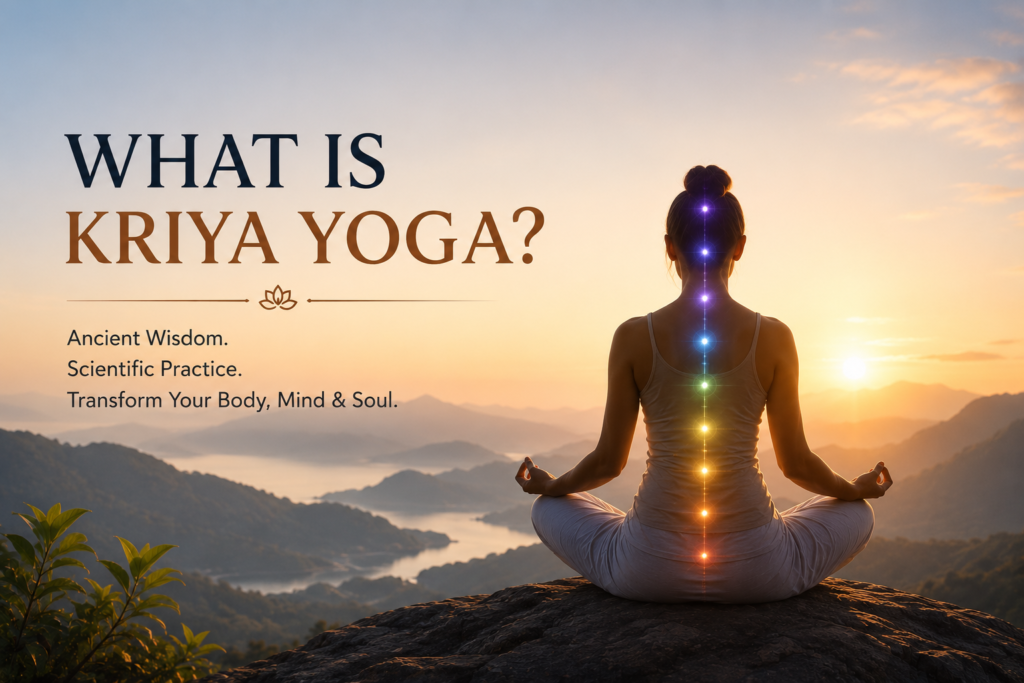
Kriya Yoga is not a modern wellness hack. It is one of the world’s oldest, most scientifically grounded spiritual practices. Rooted in ancient Indian tradition and supported by centuries of real human experience, Kriya Yoga offers a clear, systematic path to mental clarity, physical vitality, and deep inner peace.
Key Definition
The word kriya comes from the Sanskrit root kri, meaning to do or action. Yoga means union. Together, Kriya Yoga means the yoga of conscious action a practice where deliberate, disciplined techniques are used to rapidly merge individual consciousness with universal consciousness. In its most practical terms, Kriya Yoga is a complete spiritual system that includes the following:
Pranayama controlled breathing techniques that regulate life force energy
Meditation focused awareness practices that calm the mind
Mantras sacred sound vibrations used to deepen concentration
Mudras and bandhas physical gestures and energy locks that direct prana within the body
Unlike many other yoga styles practiced today, Kriya Yoga is not primarily about physical posture. Its main work is internal in the nervous system, breath, and mind.
The History and Origins of Kriya Yoga
To truly understand what Kriya Yoga is, you must understand where it came from.
In ancient texts, Kriya Yoga can be traced back to the Yoga Sutras of Patanjali, written around 400 CE. In Chapter 2, Patanjali explicitly describes Kriya Yoga as a practice built on three pillars: tapas (self-discipline), svadhyaya (self-study), and ishvara pranidhana (surrender to a higher principle). Patanjali described it as a basic practice for removing impurities and creating the clarity necessary for deep meditation.
However, the specific breathing Kriya Yoga techniques that most people refer to today were revived and formalized by the renowned Himalayan saint Mahavatar Babaji. In 1861, he introduced these techniques to Lahiri Mahasaya, instructing him to share them with true spiritual seekers in today’s world.
Lahiri Mahasaya passed these techniques on to Sri Yukteswar Giri, who in turn initiated Paramahansa Yogananda the man who introduced Kriya Yoga to the West. In his famous 1946 autobiography, Autobiography of a Yogi, Yogananda described Kriya Yoga as a spiritual airplane a faster path to self-realization than the bullock cart of typical spiritual development.
Today, several original schools carry on this tradition, including the following:
Self-Realization Fellowship (SRF) founded by Yogananda
Yogoda Satsanga Society of India (YSS) the Indian branch of SRF
Ananda Sangha founded by Swami Kriyananda, a direct disciple of Yogananda
Kriya Yoga International carries on the lineage of Roy Eugene Davis.
Each school has its own approach to initiation and instruction, but the core techniques are rooted in the same ancient source.
The Three Pillars of Kriya Yoga (Patanjali’s Framework)
Understanding the fundamental philosophy gives the practice its true depth.
1. Tapas Self – Discipline Tapas is the fire of commitment. It means remaining consistent in your practice, even when life gets busy or motivation wanes. In the case of Kriya Yoga, tapasya is what separates those who experience transformation from those who merely read about it. It’s not self-punishment it’s intentional, patient dedication to inner work.
2. Swadhyaya Self – Study Swadhyaya means turning the gaze inward. It involves observing one’s thinking patterns, emotional reactions, and habitual behaviors without judgment. It also includes the study of sacred texts not for the sake of memorizing principles, but for a deeper understanding of oneself. This contemplative practice is what, over time, builds true wisdom.
3. Ishvara Pranidhana – Surrender to a Higher Principle This pillar asks practitioners to relinquish their ego’s grip on results. Whether understood as surrender to God, the universe, or pure consciousness, this practice fosters humility and trust. It is a cure for anxiety the recognition that a greater intelligence is at work beyond the human mind.
How Kriya Yoga Works: The Science of the Spine and Breath
This is where Kriya Yoga gets really interesting and this is where it differs from almost every other spiritual practice.
The central claim of Kriya Yoga is that human consciousness is directly connected to the spine and breath. The spine houses the central nervous system, and along it run the main energy channels known in the yogic tradition as Ida, Pingala, and Sushumna. The chakras the seven main energy centers are located along this spinal column.
The main Kriya technique involves a specific pranayama practice in which the breath is used to circulate prana (life force energy) up and down the spine, activating and purifying each energy center one by one. Each completed round of this breath cycle is said to contribute significantly to the practitioner’s spiritual evolution. From a physiological perspective, the effects of this practice are evident:
- It increases blood oxygenation.
- It lowers cortisol levels, the main stress hormone.
- It activates the parasympathetic nervous system, which shifts the body out of fight-or-flight mode.
- It stimulates the vagus nerve, which controls the brain-gut-heart connection.
- It produces a brainwave state similar to that associated with deep meditation and increased creativity.
This is no myth. Researchers at institutions like the All India Institute of Medical Sciences (AIIMS) and several Western universities have studied pranayama-based practices and observed significant improvements in cardiovascular health, mental health, and neurological function.
Proven Benefits of Kriya Yoga
Kriya Yoga practitioners consistently report three distinct benefits:
Mental and Emotional Benefits
- Significant reduction in chronic anxiety and stress
- Improved ability to focus and maintain attention
- Greater emotional stability and reduced reactivity
- Relief from symptoms of mild to moderate depression
- Increased creativity and problem-solving capacity
Physical Benefits
- Improved sleep quality and faster recovery from fatigue
- Lowered blood pressure and improved heart rate variability
- Strengthened immune function due to reduced stress hormones
- Increased energy levels throughout the day
- Better regulation of the autonomic nervous system
Spiritual and Psychological Benefits
- A deeper sense of inner peace and contentment
- Greater clarity about life’s purpose and direction
- Unwinding of deep-seated emotional patterns and past conditioning
- Increased awareness and moments of genuine peace
- A sense of connection to something greater than oneself
These are not abstract promises. These are the reported experiences of millions of practitioners over decades from scientists and doctors to artists and working professionals.
Kriya Yoga vs. Other Yoga and Meditation Methods
Many people ask how Kriya Yoga differs from other popular practices.
Kriya Yoga vs. Hatha Yoga: Hatha Yoga focuses primarily on physical postures (asanas) and basic breathwork to improve health and flexibility. Kriya Yoga uses the body as a starting point but quickly transitions into energy work and meditation. It is less about the physical form and more about what goes on within.
Kriya Yoga vs. Mindfulness Meditation: Mindfulness is an excellent practice for stress reduction and present-moment awareness. Kriya Yoga incorporates this quality of awareness but goes beyond it it actively works to transform the energy body and accelerate psychological and spiritual evolution.
Kriya Yoga vs. Transcendental Meditation (TM): TM uses mantra repetition to reach a relaxed, alert state. Kriya Yoga uses breath, mantra, and energy techniques together, making it a more comprehensive system.
Common Mistakes Beginners Should Avoid
Starting Kriya Yoga without guidance can lead to frustration or lack of results. Here are the most common mistakes:
Practicing without prior training: The entire Kriya technique is traditionally taught by a teacher. Trying to understand it solely from books often leads to incorrect practice.
Irregularity: Even 20 minutes of daily practice is better than a two-hour session once a week. Regularity is key.
Expecting immediate results: Kriya yoga works deeply and gradually. Impatience can cause practitioners to abandon practice before real benefits are seen.
Skipping preparatory practice: Before starting formal Kriya, one should begin basic pranayama and meditation practices. These are not optional extras they are essential preparations.
How to Begin Your Kriya Yoga Journey
If you’re ready to explore, here’s a clear, practical starting point:
Start with daily pranayama practice nadi shodhana (alternate nostril breathing) for 10–15 minutes every morning. This alone will calm and clear your mind.
Develop a meditation habit After breathing, sit quietly for 10 minutes. Focus on your breath or a simple mantra.
Read basic books Paramahansa Yogananda’s Autobiography of a Yogi and The Yoga Sutras of Patanjali are essential readings.
Get a real initiation When you truly feel ready, contact an authorized organization like Self-Realization Fellowship or Yogoda Satsanga Society of India to apply for Kriya initiation.
Practice with sincerity, not haste Kriya Yoga rewards patience and true intention above all else.
Final Words
So, what is Kriya Yoga? It is one of the most advanced and time-tested systems for human development ever devised. It is a practice that works on every level physical, mental, energetic, and spiritual with a precision that few other traditions can match. In a world that constantly draws attention outward, Kriya Yoga offers something unique: a structured, proven way to go within and find a quality of peace, clarity, and aliveness that no external circumstances can give or take away.
The path exists. The only question is whether you are ready to walk it.
What is Kriya Yoga, and how is it different from regular yoga?
Kriya Yoga is an ancient spiritual practice that uses controlled breathing, meditation, and energy techniques to accelerate inner growth and self-realization. Unlike regular yoga, which focuses primarily on physical posture, Kriya Yoga primarily works on the nervous system and the life force energy that flows through the spine.
Can anyone learn Kriya Yoga, or do you need a guru?
Initial practices can be learned alone, but the core Kriya technique is traditionally taught through formal initiation by an authorized teacher or organization. This isn’t just tradition the technique is accurate, and proper guidance ensures it’s practiced safely and effectively.
How long does it take to feel the benefits of Kriya Yoga?
Most practitioners notice improvements in sleep, stress levels, and mental clarity within four to eight weeks of daily, consistent practice. Profound energetic and spiritual changes typically occur over months and years. The depth of benefits depends directly on the regularity and sincerity of practice.
Is Kriya Yoga affiliated with any religion?
No. Kriya Yoga is a universal spiritual science, not a religion. It does not require adherence to any specific faith, belief system, or religious identity. Practitioners from all religious backgrounds and those without have found it equally effective and easy to practice.